
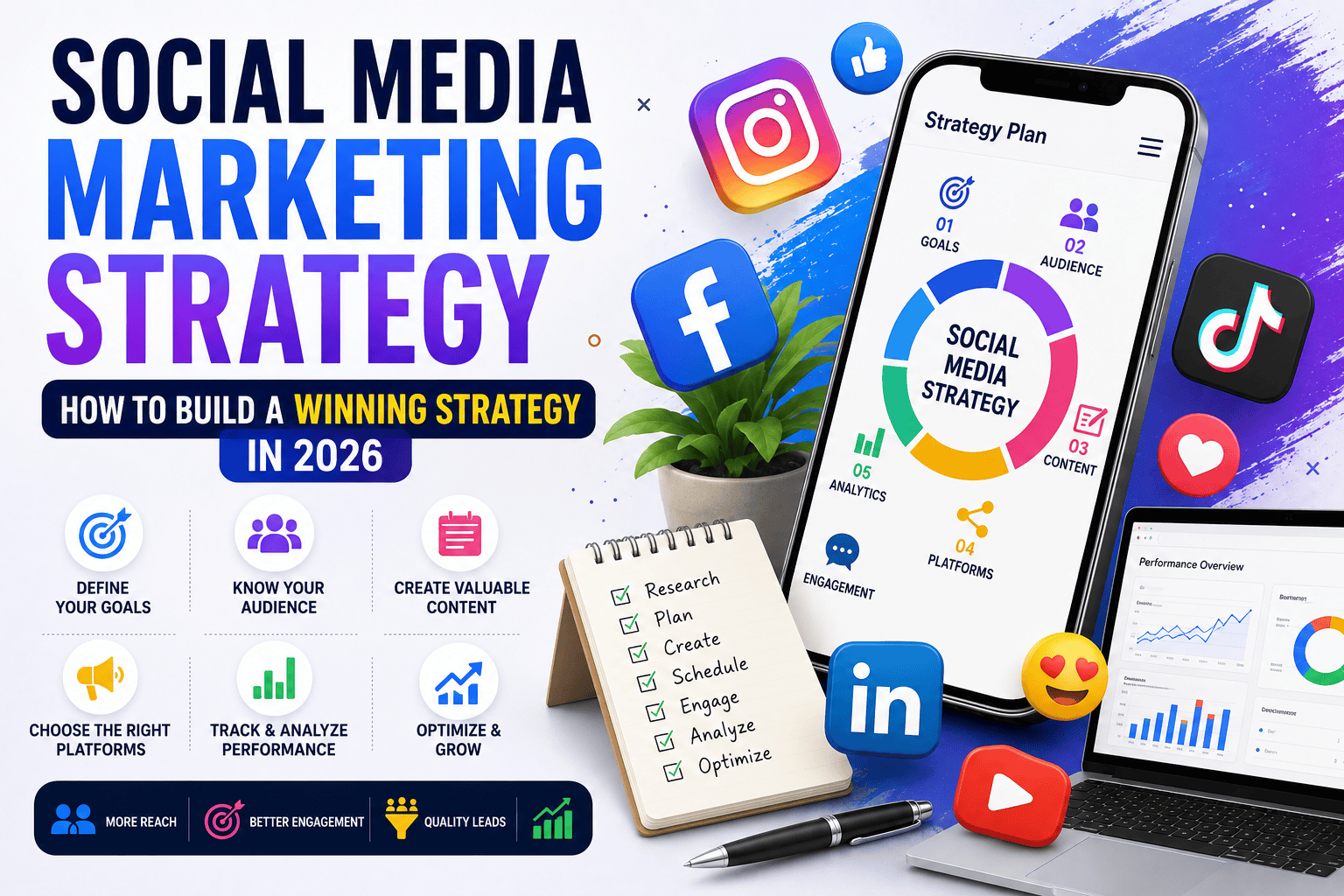

Social Media Marketing Strategy: How to Build a Winning Strategy in 2026
Posting on social media every day sounds productive, but without direction it rarely produces real business results. A strong Social Media Marketing Strategy is what separates brands that grow steadily from those that post into the void and wonder why nothing changes. If you want your social channels to actually support your business goals in 2026, you need a plan — not just a posting habit.
In this guide, we’ll walk through exactly how to build a practical, results-focused social media strategy, step by step.
Table of Contents
- What Is a Social Media Marketing Strategy?
- Why Do You Need a Social Media Marketing Strategy in 2026?
- How to Create a Social Media Marketing Strategy
- Social Media Platforms Compared
- Organic vs Paid Social Media Marketing
- How Often Should You Post on Social Media?
- Common Social Media Marketing Mistakes to Avoid
- How to Measure the Success of Your Social Media Marketing Strategy
- Final Thoughts
- FAQs
What Is a Social Media Marketing Strategy?
A social media marketing strategy is a documented plan that outlines what you want to achieve on social platforms and how you’ll get there. It covers your goals, your audience, the platforms you’ll use, the type of content you’ll create, and how you’ll measure success.
This is very different from random posting. Random posting means sharing content whenever you feel like it, with no clear purpose behind each post. A strategy, on the other hand, connects every post back to a specific objective — whether that’s brand awareness, traffic, or leads.
Social media should support your broader business goals, not exist in isolation. If your business goal is to grow sales, your social strategy should include steps that move people toward that outcome, not just generate likes. Having clear objectives from the start makes it much easier to decide what to post, where to post it, and how to judge whether it’s working.
Why Do You Need a Social Media Marketing Strategy in 2026?
Competition for attention on social media continues to grow, and platforms regularly adjust how content is shown to users. Without a plan, it’s easy to get lost in the noise.
A few reasons a clear strategy matters more than ever:
- Increased competition — more businesses are investing in social content, so standing out takes intention.
- Changing algorithms — platforms adjust how content is distributed, and a strategy helps you stay adaptable instead of reactive.
- Short-form video growth — formats like Reels and TikTok videos continue to play a major role in how people discover brands.
- Organic and paid working together — relying on only one approach limits your reach and results.
- Audience understanding — knowing who you’re speaking to shapes every other decision you make.
- Measuring real results — likes and followers look nice, but a strategy should ultimately track outcomes like traffic, leads, and sales.
How to Create a Social Media Marketing Strategy
Building an effective strategy doesn’t need to be complicated. Below is a practical, step-by-step process you can follow whether you’re starting from scratch or refining an existing approach.
1. Define Your Social Media Goals
Start by identifying what you actually want social media to do for your business. Common goals include:
- Brand awareness
- Website traffic
- Lead generation
- Sales
- Customer engagement
- Community building
Your goals should connect directly to your broader business objectives. If your business is focused on growing revenue this year, your social goals might center on driving traffic and generating leads rather than simply growing follower counts. If you want help turning social activity into actual leads, our team can help you [generate leads online].
2. Understand Your Target Audience
You can’t create content that resonates if you don’t know who you’re speaking to. Take time to understand:
- Demographics (age, location, income level, etc.)
- Interests and hobbies
- Problems and needs your product or service solves
- Online behaviour — when and how they use social media
- Content preferences (video, images, text)
- Customer pain points
You don’t need overly detailed personas to get value from this step. A simple summary of your ideal customer’s needs and habits is often enough to guide better content decisions.
3. Choose the Right Social Media Platforms
Not every platform suits every business, and trying to maintain a presence everywhere often spreads resources too thin. Instead, choose platforms based on where your audience actually spends time.
- Instagram — strong for visual brands, lifestyle, retail, and younger audiences.
- Facebook — useful for community building, local businesses, and a broad age range.
- LinkedIn — best suited for B2B businesses, professional services, and thought leadership.
- YouTube — ideal for in-depth, educational, or entertainment content with long-term visibility.
- TikTok — effective for short-form, trend-driven content aimed at younger, highly engaged audiences.
A B2B software company, for example, may get far more value from LinkedIn than from TikTok, while a fashion brand might see the opposite.
4. Analyze Your Competitors
Looking at what competitors are doing can reveal useful insights, including:
- Which platforms they’re active on
- The type of content they publish
- How their audience engages with that content
- Gaps in their content that you could fill
- Opportunities to differentiate your brand
The goal here isn’t to copy what competitors do. Instead, use this research to find gaps and opportunities where your brand can offer something different or better.
5. Create a Content Strategy
A well-rounded content mix keeps your audience engaged without feeling overly promotional. Consider blending:
- Educational content
- Entertaining content
- Promotional content
- Behind-the-scenes content
- Customer stories and testimonials
- Short-form videos
- Carousels and images
- Long-form videos
A good rule of thumb is to prioritize value-driven content most of the time, reserving promotional posts for a smaller portion of your calendar. This keeps your audience engaged rather than feeling like they’re constantly being sold to.
6. Build a Social Media Content Calendar
Planning content in advance helps maintain consistency and makes it easier to organize campaigns around key dates or launches. A calendar also leaves room for timely, reactive content when relevant opportunities arise.
A simple weekly example might look like this:
- Monday — Educational tip or how-to post
- Wednesday — Behind-the-scenes or team content
- Friday — Customer story or testimonial
- Saturday — Entertaining or trend-based short video
This is just a starting framework — the right rhythm depends on your resources and audience.
7. Create Engaging and Platform-Specific Content
Once your calendar is in place, focus on making each post effective. Strong content typically includes:
- A clear hook in the first few seconds or lines
- A clear, simple message
- Good visual quality
- Captions that add context or value
- A clear call-to-action
Posting identical content across every platform isn’t always effective, since audience expectations and formats differ. A LinkedIn post written for professionals may not land the same way on TikTok, and vice versa.
8. Combine Organic Social Media with Paid Advertising
Organic content builds trust and engagement over time, while paid advertising helps you reach specific audiences faster. Together, they can support each other.
- Use organic content to build relationships and demonstrate expertise.
- Use paid ads to reach new, targeted audiences.
- Retarget people who’ve already engaged with your content.
- Test different creatives and messages to see what resonates.
- Base paid campaigns on clear objectives, not guesswork.
If you’re weighing platforms for paid campaigns, our comparison of [Google Ads vs Facebook Ads] can help you decide where to invest.
9. Track Performance and Improve Your Strategy
A strategy isn’t complete without measurement. Track metrics that connect to your actual goals, such as:
- Reach and impressions
- Engagement rate
- Website traffic from social
- Leads generated
- Conversions
- Cost per lead
- Conversion rate
Vanity metrics like follower count can be encouraging, but they don’t always reflect business impact. Focus on the numbers that tie back to the goals you defined in step one.
Social Media Platforms Compared
| Platform | Typical Audience | Best Content Formats | Marketing Strengths | Organic Opportunities | Paid Advertising Opportunities | Best Suited For |
|---|---|---|---|---|---|---|
| Broad, skews younger to mid-age | Reels, carousels, Stories | Visual storytelling, brand identity | Strong with consistent, high-quality visuals | Detailed audience targeting, retargeting | Retail, lifestyle, visual brands | |
| Broad, wide age range | Images, video, community posts | Community building, local reach | Groups and community engagement | Strong targeting options, broad reach | Local businesses, community-driven brands | |
| Professionals, decision-makers | Articles, posts, native video | Authority building, networking | Thought leadership content performs well | B2B targeting by job title/industry | B2B, professional services | |
| YouTube | Broad, all ages | Long-form video, tutorials | In-depth education, searchability | Strong long-term discoverability via search | Video ads with detailed targeting | Education, in-depth product demos |
| TikTok | Younger, highly engaged | Short-form video, trends | Fast discovery, viral potential | Strong for trend-driven, authentic content | Growing ad targeting options | Trend-focused brands, younger audiences |
Organic vs Paid Social Media Marketing
Both approaches play a role in a complete social media marketing strategy, and understanding their differences helps you allocate resources wisely.
- Cost — organic content requires time and creativity rather than direct spend; paid requires an ongoing budget.
- Speed of reach — paid ads typically reach target audiences faster than organic content alone.
- Targeting — paid platforms offer detailed targeting options based on demographics, interests, and behavior.
- Trust building — organic content tends to build credibility and relationships over time.
- Long-term value — organic content can continue generating engagement long after it’s posted.
- Scalability — paid campaigns can be scaled up or down based on budget and results.
Rather than choosing one over the other, most successful strategies use organic content to build trust and paid advertising to accelerate reach and results.
How Often Should You Post on Social Media?
There’s no single “correct” posting frequency that works for every business. The right frequency depends on several factors:
- Content quality — fewer, higher-quality posts often outperform frequent, low-effort ones.
- Available resources — consistency matters more than volume, so post at a pace you can sustain.
- Platform differences — some platforms favor more frequent posting than others.
- Audience behaviour — understanding when your audience is active helps guide timing.
- Consistency — showing up regularly, even if less often, tends to perform better than sporadic bursts of activity.
Instead of chasing a specific number, focus on maintaining a sustainable, consistent rhythm that fits your resources and audience.
Common Social Media Marketing Mistakes to Avoid
Even well-intentioned businesses fall into these common traps:
- Posting without a clear strategy
- Trying to maintain a presence on every platform at once
- Ignoring the target audience’s actual interests and needs
- Focusing only on growing followers
- Posting only promotional content
- Inconsistent branding across platforms
- Ignoring comments and direct messages
- Not including clear calls-to-action
- Not tracking conversions or business outcomes
- Copying competitors instead of differentiating
- Giving up too quickly before results have time to build
Avoiding these mistakes alone can significantly improve the effectiveness of your social media efforts.
How to Measure the Success of Your Social Media Marketing Strategy
Measuring success starts with setting measurable goals from the outset. From there:
- Track KPIs that connect directly to your goals (not just vanity metrics).
- Use platform-native analytics (Instagram Insights, Facebook Analytics, LinkedIn Analytics, etc.) to monitor performance.
- Use website analytics to see how social traffic behaves once it lands on your site.
- Track leads and conversions generated through social channels.
- Review performance on a regular schedule — weekly or monthly, depending on your resources.
- Use what you learn to refine and improve your content and targeting over time.
Consistent review and adjustment is what turns a strategy from a one-time document into an ongoing, improving process.
Final Thoughts on Building a Social Media Marketing Strategy
A strong Social Media Marketing Strategy isn’t built overnight, and it isn’t built by chance. It comes from having clear goals, understanding your audience, choosing the right platforms, creating valuable content, staying consistent, and tracking performance so you can keep improving.
There’s no guarantee of instant results — building real traction on social media takes time and ongoing effort. But with a clear, well-executed strategy, your social media presence can become a genuine driver of business growth rather than just another task on your to-do list.
If you’re ready to build a strategy tailored to your business, explore our Social Media Marketing Services or get in touch with our team through our [Contact Page]. We also offer Meta Ads Services, Digital Marketing Services, and Web Design Services to support your broader marketing goals — including guidance on how [AI in digital marketing] is shaping the industry, and tips on how to [get more customers online].
FAQs
What is a Social Media Marketing Strategy? A Social Media Marketing Strategy is a documented plan that outlines your goals, target audience, chosen platforms, content approach, and how you’ll measure results on social media.
How do I create a social media marketing strategy? Start by defining clear goals, understanding your audience, choosing the right platforms, planning your content, staying consistent, and tracking performance against your goals.
Which social media platform is best for marketing? There’s no single best platform — the right choice depends on your target audience, industry, and goals. LinkedIn often suits B2B brands, while Instagram and TikTok tend to work well for visual, consumer-facing brands.
How often should a business post on social media? There’s no universal posting frequency. It depends on your resources, platform, audience behaviour, and ability to maintain consistency and quality.
Is organic social media marketing still effective? Yes, organic social media remains effective for building trust, relationships, and long-term engagement, especially when paired with a clear content strategy.
Should businesses use paid social media advertising? Paid advertising can help extend reach and target specific audiences faster than organic content alone, but it works best as part of a broader strategy rather than a standalone approach.
How do you measure social media marketing success? Success is measured by tracking KPIs tied to your specific goals — such as engagement, website traffic, leads, and conversions — rather than relying only on likes or followers.
How long does a social media marketing strategy take to work? Results vary depending on your industry, consistency, and goals. Social media growth is typically gradual, and there are no guaranteed timelines for results.
1 Comment
[…] you post. One platform with weekly posts costs far less than daily content across several. A clear social media marketing strategy helps you plan how much content you […]
Your comment is awaiting moderation.
[…] is different from regular social media marketing. Social media marketing builds awareness. Social Commerce takes it further. It turns that attention […]
Your comment is awaiting moderation.
[…] your strategy is set, AI can help you run a social media marketing strategy. It can also help you rank higher on Google. At FreakXMedia, we combine AI-powered speed with […]