

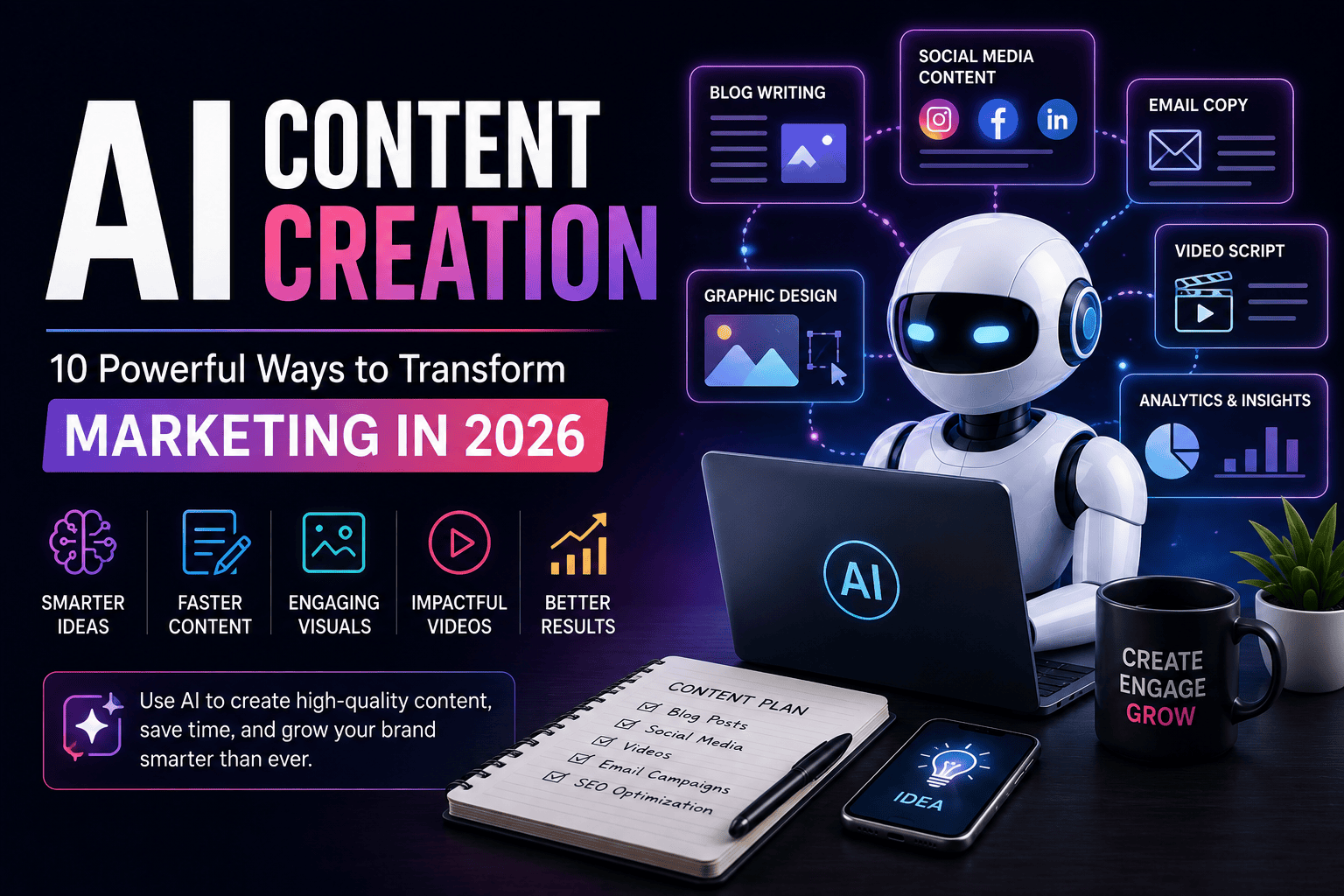

AI Content Creation
Table of Contents
- What Is AI Content Creation?
- Why Is AI Content Creation Important in 2026?
- 10 Ways AI Content Creation Can Transform Marketing
- AI Content Creation vs Human Content Creation
- Best AI Content Creation Tools
- How to Create High-Quality Content With AI
- Common AI Content Creation Mistakes
- Does AI Content Creation Replace Human Writers?
- Final Thoughts
- FAQs
If you run a business or manage marketing for one, you have probably heard people talk about AI Content Creation. Maybe you have used a tool to write a caption or generate a blog outline, and you’re still wondering what all the buzz is about.
Here is the short version. AI content creation means using artificial intelligence tools to help write, design, or plan marketing content. It does not replace your team — it supports your team, so you can produce more content in less time without losing quality.
This guide breaks down what AI content creation means, why it matters in 2026, and ten practical ways to use it starting today.
What Is AI Content Creation?
AI content creation is the process of using artificial intelligence tools to help produce marketing content — blog posts, social captions, ad copy, videos, and graphics. These tools analyze text and images, then generate a first draft based on a prompt you give them.
The main difference from traditional content creation is speed — a human might spend an hour on an outline, while AI produces a rough version in seconds.
But speed is not the same as quality. AI does not know your brand voice or customers the way your team does, and it can confidently state things that are not true. Treat AI drafts the way you would a junior team member’s first draft — always review before publishing.
Real-world example: A local bakery owner uses AI to draft five Instagram caption ideas for a new cake flavor, then picks the one that sounds most like her brand and adds a personal story. The AI saved her time; her judgment made the post actually good.
Why Is AI Content Creation Important in 2026?
Marketing teams are being asked to do more with less. Content demands keep growing across blogs, social, email, and ads — this is where AI content creation earns its place, by offering:
- Faster production — blank page to working draft, quickly
- More ideas — angles you had not considered
- Better productivity — less drafting time, more strategy time
- Easier personalization — one message adapted for many audiences
- Simpler repurposing — one blog post, several formats
- Support for small teams — more output without more people
- Scalable workflows — keeping up as content needs grow
None of this means AI produces better content automatically. It removes friction, so your team’s time goes toward the parts that actually need human judgment.
10 Ways AI Content Creation Can Transform Marketing
1. Generate Content Ideas Faster
AI can brainstorm topic lists, suggest angles, and rough out a content calendar. A human still picks which ideas are worth pursuing — AI can throw out twenty ideas in a minute, but only a few will fit your brand.
2. Create Blog Content More Efficiently
AI can speed up outlines, research questions, first drafts, and headline options. AI-written drafts still need fact-checking and editing to match your brand voice. For a deeper framework, see our guide on how to create a digital marketing strategy.
3. Create Social Media Content
AI can help with caption drafts, hooks, weekly content ideas, carousel concepts, and short-form video scripts — especially useful for testing tone and style across variations. For a full framework, see our social media marketing strategy guide.
4. Create Marketing Visuals
AI tools can assist with social graphics, ad creative ideas, and design variations for testing. Canva and Adobe Firefly offer AI-assisted design features, but capabilities change often, so check each platform directly. Visuals usually still need a designer’s touch.
5. Create Video Marketing Content
AI can support video topic ideas, script drafts, storyboards, and captions. It speeds up planning and editing, but does not replace professional production for high-stakes brand videos or on-camera talent.
6. Personalize Marketing Content
AI can help create different content versions for different audience segments, channels, and buyer stages — but only works well when based on real customer insights, not guesswork.
7. Repurpose Existing Content
One piece of work can stretch into many formats: Blog post → LinkedIn post → Instagram carousel → Short video script → Email.
Practical example: A blog post on local SEO tips can become a LinkedIn post, a five-slide carousel, and a newsletter blurb — several pieces built from work you already did.
8. Improve Email Marketing
AI can help with subject line variations, first drafts, and A/B testing concepts. Drafts still need a human check for tone and accuracy before sending.
9. Support Paid Advertising Content
AI can generate ad copy variations, headlines, and landing page drafts for Google Ads and Meta Ads. It cannot promise better return on ad spend — that still depends on targeting, budget, and offer. See our comparison of Google Ads vs Facebook Ads.
10. Improve Content Workflows
The biggest advantage of AI is how it fits into your entire workflow: research, planning, creation, editing, publishing, analytics, and optimization — not any single task alone.
AI Content Creation vs Human Content Creation
| Factor | AI Content Creation | Human Content Creation |
|---|---|---|
| Speed | Very fast first drafts | Slower, more deliberate |
| Creativity | Pattern-based, limited originality | Original ideas and creative risks |
| Personal experience | None | Real stories and expertise |
| Research accuracy | Can generate incorrect information | Can verify sources directly |
| Consistency | Consistent tone if prompted well | Consistent when brand guidelines are followed |
| Editing needs | Almost always needs review | Needs review, but fewer factual errors |
| Strategy | Cannot set goals or direction | Sets strategy and makes decisions |
| Scalability | Very easy to scale output | Harder to scale without more people |
The strongest approach is rarely AI alone or humans alone. It is AI plus human expertise — AI handles the repetitive parts, humans handle strategy, originality, and brand voice.
Best AI Content Creation Tools
Rather than claiming one tool is universally “best,” here is what each type is generally useful for:
- ChatGPT – brainstorming, drafting, and outlining
- Canva – design templates and AI-assisted graphics
- Adobe Firefly – AI-generated visuals within Adobe’s tools
- Jasper – marketing copy and brand-voice generation
- Copy.ai – short-form copy like ads and captions
- AI video tools – auto-captioning and editing assistance
Pricing and features can change, so check each provider’s website before choosing one. Focus on which category solves your bottleneck rather than chasing the “best” tool. See our guide to AI marketing tools for a broader breakdown.
How to Create High-Quality Content With AI
Generating AI text is easy. Creating genuinely useful content takes a process:
- Define your audience.
- Define the goal.
- Research the topic before prompting AI.
- Create an outline.
- Use AI to draft sections faster.
- Add your own expertise and examples.
- Fact-check every claim.
- Add unique insights for originality.
- Optimize for search intent, not just keywords.
- Edit thoroughly, then publish.
- Measure performance.
- Update when outdated.
Skipping straight from “generate” to “publish” is where most AI content strategies fail.
Common AI Content Creation Mistakes
- Publishing raw AI output — unedited text often sounds generic and can contain errors
- Creating generic content — fails to build trust if it could belong to any brand
- Keyword stuffing — hurts readability and rankings
- Using fake information — AI can state things confidently that aren’t true
- Skipping fact-checking — every claim needs verification
- Losing brand voice — default AI tone often sounds flat
- Overusing AI — removes the human insight readers connect with
- Copying competitors — creates weak, unoriginal content
- Writing only for search engines — ignores what real readers need
Does AI Content Creation Replace Human Writers?
No, not in a meaningful sense. AI can automate drafting and repetitive tasks, but human writers still bring strategic thinking, original ideas, brand voice, storytelling, and judgment about what to publish. AI works best as a productivity tool, not a replacement for people who understand your brand.
Final Thoughts on AI Content Creation
AI content creation is not going away, and there is no need to fear it. Used well, it helps marketers move faster and scale content without burning out. But the tools alone are not the strategy — the best results come from combining AI with human creativity, editing, and strategic direction.
Learn more about AI and the future of digital marketing and how it connects to generating leads online.
Want help building a content strategy that works? FreakXMedia offers content marketing, SEO, social media marketing, Google Ads, Meta Ads, and website design. Contact us to talk about what your business needs.
FAQs
1. What is AI Content Creation? AI Content Creation is the use of artificial intelligence tools to help produce marketing content, including blog posts, social captions, ad copy, and visuals.
2. How does AI Content Creation work? AI tools analyze patterns in large amounts of text and images, then generate content based on the prompts and instructions you give them.
3. What are the best AI tools for content creation? It depends on your needs. ChatGPT is useful for writing and brainstorming, Canva and Adobe Firefly help with visuals, and Jasper or Copy.ai focus on marketing copy specifically.
4. Can AI create high-quality marketing content? AI can create strong first drafts, but high-quality content usually requires human editing, fact-checking, and brand-voice adjustments.
5. Can AI Content Creation replace human writers? No. AI can speed up drafting and repetitive tasks, but strategy, original ideas, and brand voice still depend on human writers.
6. Is AI-generated content good for SEO? AI-generated content can support SEO when it is well-researched, edited, and genuinely useful to readers. Search engines prioritize helpful content over how it was produced.
7. How can businesses use AI for content marketing? Businesses can use AI for idea generation, drafting, repurposing content across channels, and speeding up email and ad copy creation.
8. How can I create better content with AI? Start with a clear outline and audience in mind, use AI to speed up drafting, then add your own expertise, fact-check everything, and edit before publishing.
1 Comment
[…] AI can suggest blog topics, outlines, first drafts, captions, ad copy, and email drafts. It can also turn one blog post into several social posts. Always fact-check and edit the result, then add your brand voice. AI content does not rank well by default. You can start with a simple workflow for AI content creation. […]