




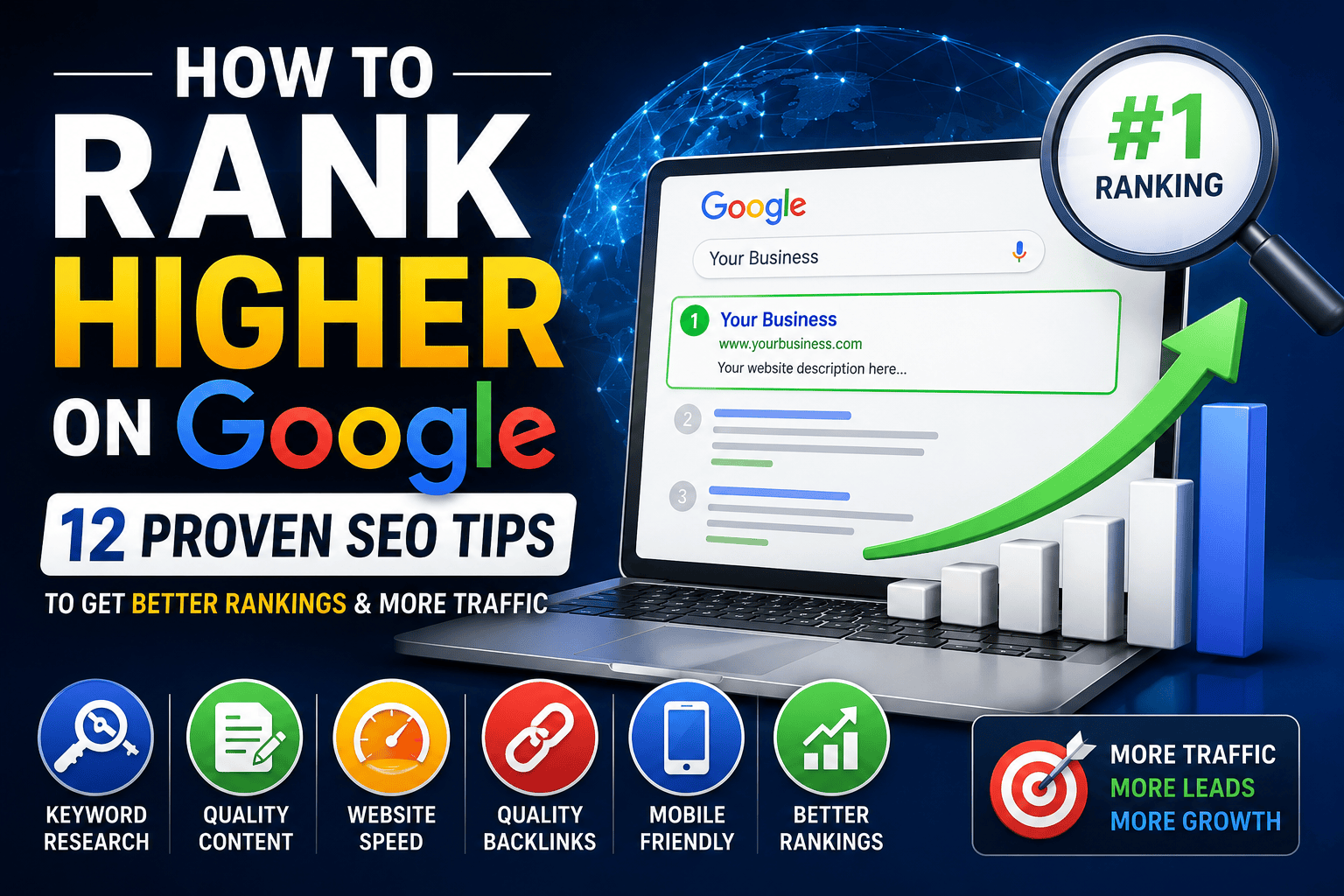

How to Rank Higher on Google: 12 Proven SEO Tips for 2026
If you run a small business, you’ve probably asked yourself how to rank higher on Google at least once. Maybe you have a great product or service, but your website barely shows up in search results. You’re not alone — most business owners face this exact challenge, especially when they’re new to SEO.
The good news is that ranking higher on Google isn’t about luck or big budgets. It’s about following the right steps consistently. In this guide, we’ll walk through 12 proven, beginner-friendly tips to help your website climb the search results and bring in more visitors, leads, and customers.
Table of Contents
- What Does It Mean to Rank Higher on Google?
- Why Ranking Higher on Google Matters for Your Business
- How to Rank Higher on Google: 12 Proven SEO Tips
- How Long Does It Take to Rank Higher on Google?
- Common SEO Mistakes That Can Hurt Your Google Rankings
- On-Page SEO vs Off-Page SEO
- How to Rank Higher on Google for Local Searches
- Quick SEO Checklist to Improve Your Google Rankings
- Final Thoughts
- FAQs
What Does It Mean to Rank Higher on Google?
When people search for something on Google, they see a list of results ranked from most to least relevant. Ranking higher simply means your website appears closer to the top of that list for the keywords your customers are searching for.
Google uses hundreds of factors to decide this order, including content quality, website speed, mobile-friendliness, and backlinks. You don’t need to master every factor. You just need to focus on the ones that matter most, which is exactly what this guide covers.
Why Ranking Higher on Google Matters for Your Business
Higher rankings aren’t just a vanity metric. They directly affect your bottom line.
- More organic traffic: Most clicks go to the first few results on the page.
- Greater visibility: Your brand gets seen by people actively searching for what you offer.
- More trust: Users often assume top-ranking sites are more credible.
- More leads: Higher visibility naturally brings in more inquiries.
- More customers: Traffic and trust eventually convert into sales.
In short, learning how to rank higher on Google is one of the most cost-effective ways to grow a business online.
How to Rank Higher on Google: 12 Proven SEO Tips
Here are 12 practical steps you can start applying today.
1. Target the Right Keywords
Keyword research is the foundation of SEO. Find out what your potential customers are actually typing into Google, then build content around those phrases. Tools can help, but thinking like your customer is just as important.
2. Create Helpful and High-Quality Content
Google rewards content that genuinely answers a searcher’s question. Avoid thin or vague pages. Instead, write in-depth, useful content that solves real problems for your audience.
3. Optimize Your Title Tags and Meta Descriptions
Your title tag and meta description are often the first thing users see in search results. Include your target keyword naturally and write copy that encourages clicks.
4. Improve Your On-Page SEO
This includes using proper heading structure (H1, H2, H3), adding descriptive image ALT text, and organizing content logically. Good on-page SEO helps Google understand what your page is about.
5. Match Search Intent
Not every keyword needs the same type of content. Some searches want a quick answer, others want a detailed guide, and some want a product page. Matching your content type to the intent behind a search is critical for rankings.
6. Improve Your Website Speed
Slow websites frustrate visitors and hurt rankings. Compress images, use caching, and choose reliable hosting. You can check your site’s performance using Google PageSpeed Insights.
7. Make Your Website Mobile-Friendly
Most searches now happen on mobile devices. Your website should load quickly and look great on smaller screens, since Google primarily uses mobile-friendliness as a ranking signal.
8. Build High-Quality Backlinks
Backlinks from reputable, relevant websites signal trust to Google. Focus on earning links through partnerships, guest posts, and genuinely useful content rather than buying low-quality links.
9. Strengthen Your Internal Linking
Linking between your own pages helps Google understand your site structure and helps visitors find related information. For example, a post about local SEO might link to a page about [optimizing your Google Business Profile].
10. Optimize Your Google Business Profile
For local businesses, a well-optimized Google Business Profile can significantly boost visibility in map results and local searches. Keep your business details accurate and up to date.
11. Improve User Experience
A clean design, easy navigation, and clear calls-to-action all contribute to how long visitors stay on your site — a factor that indirectly supports better rankings.
12. Track and Update Your SEO Strategy
SEO isn’t a one-time task. Use tools like Google Search Console to monitor performance, then refine your content and strategy based on real data.
How Long Does It Take to Rank Higher on Google?
There’s no fixed timeline, and anyone who promises guaranteed results in a specific number of days isn’t being fully honest. Generally, small businesses start seeing meaningful movement within three to six months of consistent effort, though competitive industries or keywords can take longer. Patience and consistency matter more than speed here.
Common SEO Mistakes That Can Hurt Your Google Rankings
Avoid these common pitfalls:
- Keyword stuffing — overusing keywords unnaturally
- Thin content — pages that don’t fully answer the search query
- Buying low-quality backlinks — can lead to penalties
- Slow website speed — increases bounce rates
- Ignoring mobile users — hurts both rankings and user experience
- Poor internal linking — makes it harder for Google to crawl your site
- Not matching search intent — even great content underperforms if it doesn’t fit what users are looking for
On-Page SEO vs Off-Page SEO
| Aspect | On-Page SEO | Off-Page SEO |
|---|---|---|
| Definition | Optimization done directly on your website | Actions taken outside your website |
| Examples | Content, headings, meta tags, internal links | Backlinks, social shares, brand mentions |
| Control Level | Fully within your control | Partially within your control |
| Primary Goal | Help Google understand your content | Build trust and authority |
| Impact Timeframe | Can show results relatively quickly | Often takes longer to build |
Both work together. Strong on-page SEO gives you a solid foundation, while off-page SEO builds the authority needed to compete for higher rankings.
How to Rank Higher on Google for Local Searches
If you run a local business, local SEO deserves special attention. Start by making sure your business information is consistent across the web, then focus on [Google Business Profile Optimization] and [local SEO for small businesses] to improve your visibility in map packs and “near me” searches. These steps are often faster to see results from than broader national SEO efforts.
Quick SEO Checklist to Improve Your Google Rankings
- Research and target relevant keywords
- Write helpful, in-depth content
- Optimize title tags and meta descriptions
- Use proper heading structure
- Match content to search intent
- Improve website speed
- Ensure mobile-friendliness
- Build quality backlinks
- Add internal links between related pages
- Optimize your Google Business Profile
- Monitor performance with Search Console
- Update and improve content regularly
Final Thoughts on How to Rank Higher on Google
Learning how to rank higher on Google doesn’t require shortcuts or guesswork. It requires the right strategy, applied consistently over time. From keyword research to technical improvements and local SEO, every step in this guide plays a part in building sustainable, long-term visibility.
If you’d rather focus on running your business while experts handle your SEO, website design, and digital marketing, [contact FreakXMedia] for a tailored strategy built around your goals.
FAQs
1. How to rank higher on Google? Focus on quality content, solid on-page SEO, good site speed, mobile-friendliness, and building trustworthy backlinks over time.
2. How long does it take to rank higher on Google? Most small businesses see noticeable progress within three to six months, though this varies by industry and competition.
3. Can I rank on Google without paying? Yes. Organic SEO doesn’t require ad spend, though it does require consistent time and effort.
4. Does blogging help Google rankings? Yes, regularly publishing helpful, relevant blog content can improve visibility and attract more organic traffic over time.
5. How often should I update my website for SEO? Reviewing and refreshing key pages every few months helps keep content accurate and competitive in search results.
6. Do backlinks still matter for SEO? Yes, quality backlinks remain one of the strongest trust signals Google uses to evaluate websites.
7. How can a small business rank higher locally? Optimizing your Google Business Profile and focusing on local SEO fundamentals are two of the most effective starting points.
1 Comment
[…] Start by learning to understand how SEO works. Search is also changing, so it helps to optimize content for AI-powered search. If you want the basics of getting found, read how to rank higher on Google. […]
Your comment is awaiting moderation.
[…] “Understanding how to rank higher on Google gives you a real advantage.” → rank higher on Google […]
Your comment is awaiting moderation.
[…] offers [SEO Services] to build long-term organic visibility. You can also learn more about how to [rank higher on Google] in our detailed […]
Your comment is awaiting moderation.
[…] you’re unsure where to start, our team can help you [get more customers online] through a strategy tailored to your specific business and […]